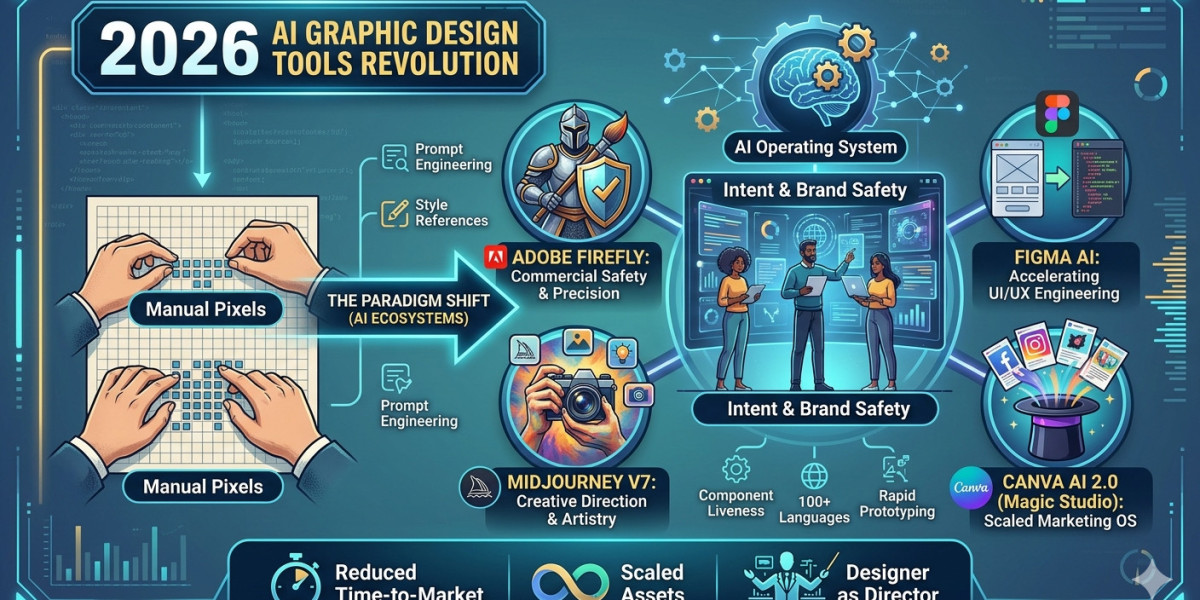

The creative landscape has experienced a monumental paradigm shift. In 2026, artificial intelligence is no longer viewed as a disruptive novelty; it has matured into the core structural operating system of modern visual communication. Today’s graphic design ecosystem requires a sophisticated blend of human creative direction and high-density machine intelligence to scale digital assets efficiently.
Whether you are an enterprise agency founder protecting intellectual property or a freelance UI/UX designer optimizing conversion workflows, staying competitive means integrating specialized generative AI systems into your daily infrastructure.
Below is an authoritative analysis of the definitive, industry-standard AI graphic design tools dominating the global creative sector this year.
1. Adobe Firefly: The King of Commercial Safety and Precision Editing
For professional design agencies, corporate brand teams, and enterprise digital marketers, legal protection and compliance are non-negotiable. Adobe Firefly stands out as the ultimate industry benchmark for legally compliant, commercial-safe generative design.
Core Architectural Strength: Trained exclusively on fully licensed assets, public domain materials, and Adobe Stock datasets, removing all intellectual property liabilities and copyright ambiguities.
Workflow Integration: Natively embedded within Adobe Creative Cloud applications like Photoshop and Illustrator, powering next-generation features such as Generative Fill, Generative Expand, and Style Reference Matching.
Best Used For: Commercially safe commercial production, brand asset generation, high-value client presentations, and precise raster manipulation.
2. Figma AI & Figma Make: Accelerating UI/UX Engineering
Interface engineering and digital product design require systematic consistency rather than abstract art. Figma AI (alongside its Figma Make engine) has completely solved the "blank canvas paralysis" for UI/UX teams globally.
Core Architectural Strength: Converts complex natural language prompts directly into component-level, fully responsive layout structures that strictly respect established design tokens and UI components.
Workflow Integration: Features native "Dev Mode" to instantly translate wireframe designs into clean, production-ready front-end code spec sheets.
Best Used For: Fast UI/UX prototyping, web and mobile app wireframing, automatic layer organization, and streamlining the designer-to-developer pipeline.
3. Midjourney V7: The Absolute Benchmark for Creative Direction and Artistry
When it comes to raw aesthetic sophistication, photorealism, and advanced style consistency, Midjourney remains the unassailable leader in prompt-to-image synthesis.
Core Architectural Strength: The proprietary V7 model brings exceptional stylistic control, unmatched depth in texture rendering, and advanced character preservation across multiple generations.
Workflow Integration: Primarily utilized in the exploratory ideation phase. Designers leverage parameters like --sref (Style Reference) to look and lock a uniform visual direction across expansive marketing campaigns.
Best Used For: Moodboarding, high-fidelity conceptual art, creative advertising direction, and abstract visual exploration.
4. Canva AI 2.0 (Magic Studio): The Creative Operating System for Scaled Marketing
Serving as a massive catalyst for creative democratization, Canva AI 2.0 has transitioned from a simple template site into an all-in-one Creative Operating System.
Core Architectural Strength: Features the revolutionary Magic Layers utility, which automatically breaks down flat, unlayered PNG or JPG files into fully isolated, editable elements within seconds.
Workflow Integration: Powered by tools like Magic Switch, it lets marketing teams instantly cross-adapt a single presentation layout into multi-format localized social media carousels in over 100 languages simultaneously.
Best Used For: Rapid high-volume digital content production, brand guide alignment, and automated presentation design.
Frequently Asked Questions
What are the best AI tools for professional graphic designers in 2026?
The best AI design tools in 2026 include Adobe Firefly for commercial-safe editing, Figma AI for accelerated UI/UX layouts, Midjourney V7 for high-fidelity concept art, and Canva AI 2.0 for automated high-volume brand asset generation
Is AI replacing human graphic designers?
No, generative AI is not replacing graphic designers; instead, it is shifting their role from manual pixel execution to high-level system thinking, machine experience (MX) alignment, and creative direction. Designers leveraging AI tools significantly reduce time-to-market and prototyping cycles.
Which AI tool generates vector graphics natively?
Adobe Firefly (integrated within Adobe Illustrator) and specialized platforms like Recraft generate native SVG vector formats, allowing designers to export scalable icons, brand logos, and digital illustrations without resolution loss.
SXO & User Experience: Why Intent Matters Most
As the digital ecosystem shifts toward personalized visual delivery, great design is no longer just about aesthetics—it is about Intent. Modern Search Experience Optimization (SXO) prioritizes platforms that minimize cognitive fatigue for users.
By using advanced tools to construct adaptive systems rather than static layouts, designers can build intuitive user interfaces that satisfy both human intent and engine crawling algorithms effortlessly.