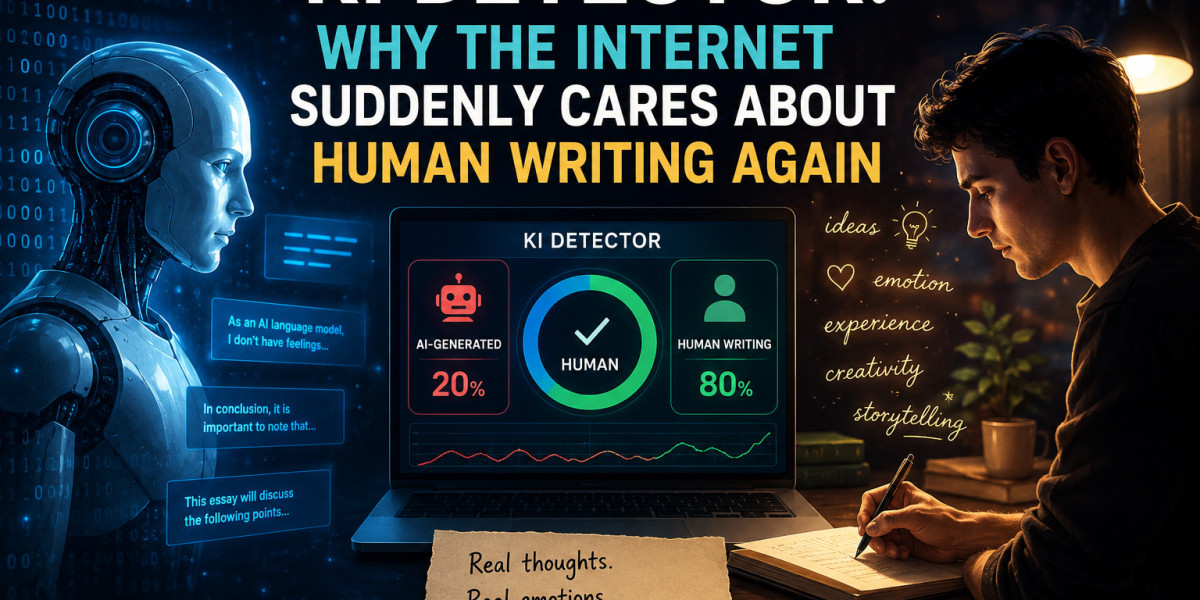

Every day, more of what we read online starts life inside a machine. From product descriptions to student essays, artificial intelligence now shapes a huge slice of written content. That shift has created a pressing question: can we still tell whether a real person wrote something? The answer, increasingly, lives inside a tool called the KI detector.
What Is a KI Detector?
The letters "KI" come from the German words Künstliche Intelligenz, meaning artificial intelligence. So a KI detector is simply software built to figure out whether text came from a human mind or an AI program. You paste in a paragraph, click a button, and the tool hands back its best guess along with a confidence score.
These scanners have exploded in demand because writing bots have become remarkably talented. When a chatbot can draft a heartfelt letter or a polished blog post in seconds, spotting the difference by eye alone becomes nearly hopeless. A KI detector fills that gap, giving people a way to check what they can no longer verify on their own.
How the Technology Reads Between the Lines
Behind every KI detector sits a mix of statistics and pattern hunting. Machine-written passages tend to behave in tidy, foreseeable ways. Language models usually reach for the safest, most expected word at each step, creating prose that flows well but feels oddly flat. People write differently. We ramble, break rhythm, toss in strange comparisons, and let emotion bend our sentences into shapes no formula predicts.
Detectors focus on two telling signals. One is how predictable the wording is, since overly smooth text often hints at a machine. The other is how much sentence length and structure jump around. A human writer bounces between quick, snappy lines and long, twisting ones, while AI leans toward a steadier beat. By measuring these traits, the tool calculates the odds that a robot produced the words.
Who Actually Uses These Tools?
Teachers led the charge. Schools and universities lean on KI detectors to confirm that students wrote their own papers instead of handing the job to a chatbot. Website owners and content managers use them to guarantee the articles they publish carry real human value, which matters enormously for search rankings.
Companies have embraced them too. Recruiters checking cover letters, editors reviewing submissions, and platforms fighting spam all depend on detection to protect quality and honesty. In an internet crowded with automated noise, these tools help genuine voices rise above the clutter.
Why They Aren't Flawless
For all their promise, KI detectors stumble often. Sometimes they wrongly brand honest human writing as machine-made, which can unfairly harm a student or a professional. Other times, lightly reworded AI text sails straight through undetected. Because of this, experts warn against treating any score as absolute proof. A detector should offer a clue, never a courtroom verdict.
This imperfection fuels ongoing debate, especially in classrooms where a mistaken flag can bruise a reputation. As AI grows sharper, detectors must keep evolving, forever chasing the very systems they hope to catch.
What Comes Next
The road ahead looks both cloudy and thrilling. Some specialists suspect that human and machine writing will one day blend so seamlessly that no scanner can separate them. Others place their hopes in hidden watermarks, quiet signals baked directly into AI output that reveal its origin without any guesswork.
Whatever arrives, the detector IA stands for something bigger than software. It reflects our stubborn wish to understand and steer the intelligent tools we keep building. In a world overflowing with borrowed sentences, these silent watchdogs remind us that truth and authorship still hold real worth.