1. Safe Positioning (Top Left): Illustrates how to minimize overlap with your rearview mirror by leaving only a tiny sliver of your own car visible.
2. Wide Visibility (Top Right): Shows the goal of capturing traffic in adjacent lanes so a car moving out of your rearview mirror immediately appears in your side-view mirror.
3. Safe Following Distance (Bottom Left): A green-highlighted section demonstrating when a car is far enough behind to merge safely.
4. Danger Zone: Tailgating (Bottom Right): A red-highlighted section showing when another vehicle is too close to allow for a safe lane change.

image

🚗 Master Your Drive: The Ultimate Guide to Perfect Seating & Road Judgment!
Driving isn't just about moving the wheel; it's about how you sit and how you see. Check out these pro-tips to stay comfortable and safe on every journey!

1. Perfect Seating Ergonomics
Backrest Angle: Set your seat at a 115° angle with a slight 15° to 20° slant. This supports the natural curve of your spine and prevents lower back pain.

Leg Position: Maintain a 135° bend in your knees. This ensures you have enough leverage to press the pedals fully without overextending.

The "Heel Grounded" Rule: Always keep your heel on the floor. Use it as a pivot point to toggle between the accelerator and brake for smoother control.

Arm Reach: Your elbows should have a comfortable bend. A common rule is that your wrists should touch the top of the steering wheel when your arms are extended.

2. Steering & Head Position
Head Rest: The center of the headrest should be level with the top of your ears to prevent whiplash in case of an accident.

Eye Level: Position your seat so your line of sight is clear over the dashboard but allows you to see the road immediately in front of the hood.

Hand Placement: The "8-3" or "9-3" holding position (referring to clock positions) provides the most leverage and safety if the airbag deploys.

3. Road Judgment & Lane Positioning
Center Reference: Use the center of your dashboard or a specific hood ornament to align with the middle of your lane.

Wheel Placement: The image shows how to use dashboard "markers" (like the edges of the instrument cluster) to judge exactly where your left and right tires are hitting the road.

Side Gaps: Learning the "Side Judgment Gap" helps you navigate narrow streets and overtake safely without clipping mirror.
Make photos

image

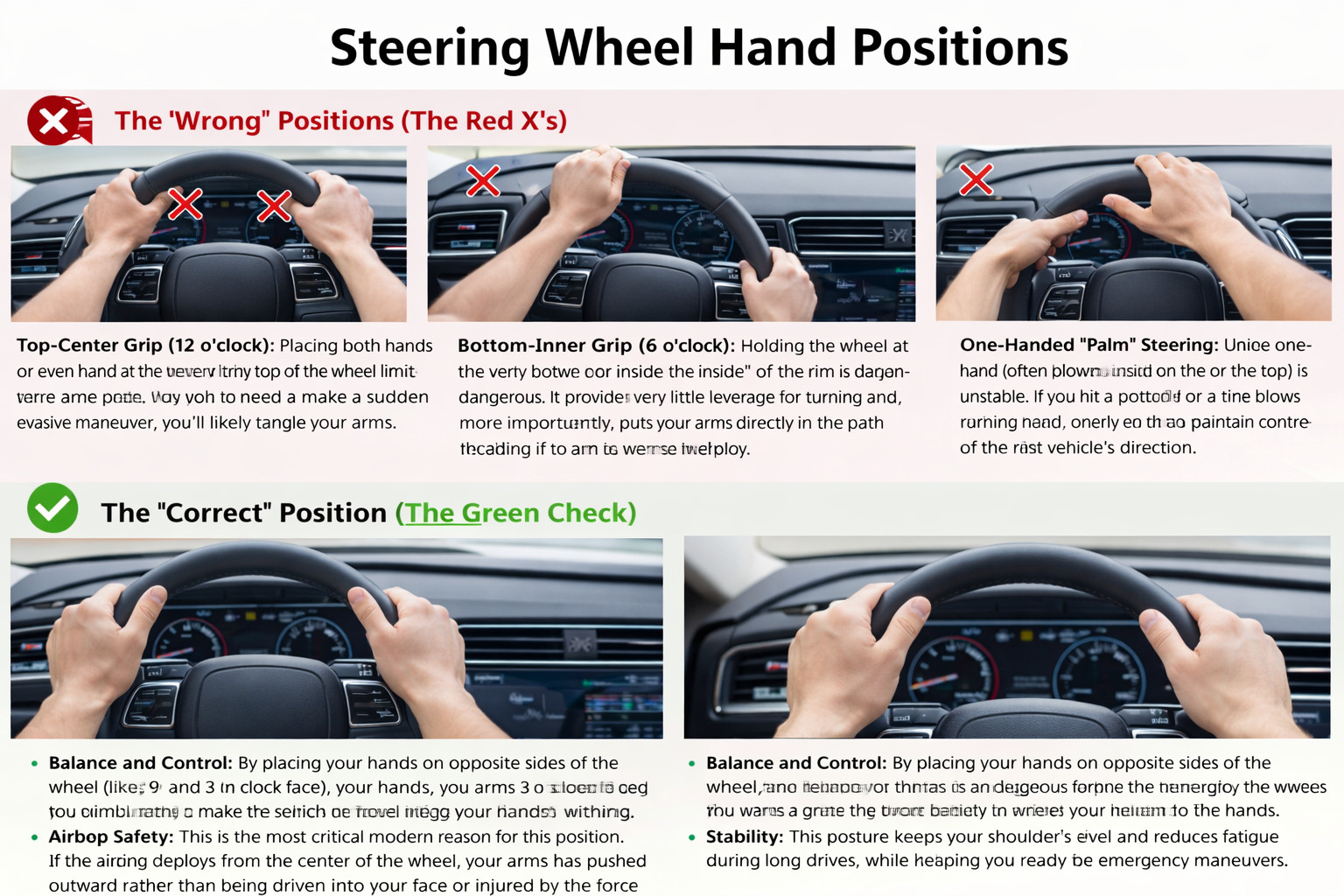
steering wheel hand positions, explaining why certain methods are discouraged and what the gold standard is for safe driving.
​The "Wrong" Positions (The Red X's)
​Top-Center Grip (12 o’clock): Placing both hands or even one hand at the very top of the wheel limits your range of motion. If you need to make a sudden evasive maneuver, you’ll likely tangle your arms.
​Bottom-Inner Grip (6 o’clock): Holding the wheel at the very bottom or from the "inside" of the rim is dangerous. It provides very little leverage for turning and, more importantly, puts your arms directly in the path of the airbag if it were to deploy.
​One-Handed "Palm" Steering: Using one hand (often placed on the horn or the top) is unstable. If you hit a pothole or a tire blows out, one hand is rarely enough to maintain control of the vehicle’s direction.
​Cross-Arm/Over-Top Grip: Reaching across the wheel or gripping it with an awkward overhand hook limits your ability to make smooth, continuous turns and can lead to oversteering.
​The "Correct" Position (The Green Check)
​The bottom image illustrates what is commonly known as the 9 and 3 position.
​Balance and Control: By placing your hands on opposite sides of the wheel (like 9 and 3 on a clock face), you have maximum leverage to turn the wheel quickly in either direction without moving your hands.
​Airbag Safety: This is the most critical modern reason for this position. If the airbag deploys from the center of the wheel, your arms are pushed outward rather than being driven into your face or injured by the force of the bag.
​Stability: This posture keeps your shoulders level and reduces fatigue during long drives, while keeping you ready for emergency maneuvers.
​Pro-Tip: The "Thumb" Rule
​In the "Correct" image, notice the driver's thumbs are resting along the rim rather than hooked tightly around it. In a collision, the steering wheel can "kick" or spin violently; keeping your thumbs on the surface helps prevent them from being sprained or broken.
Make photo
image

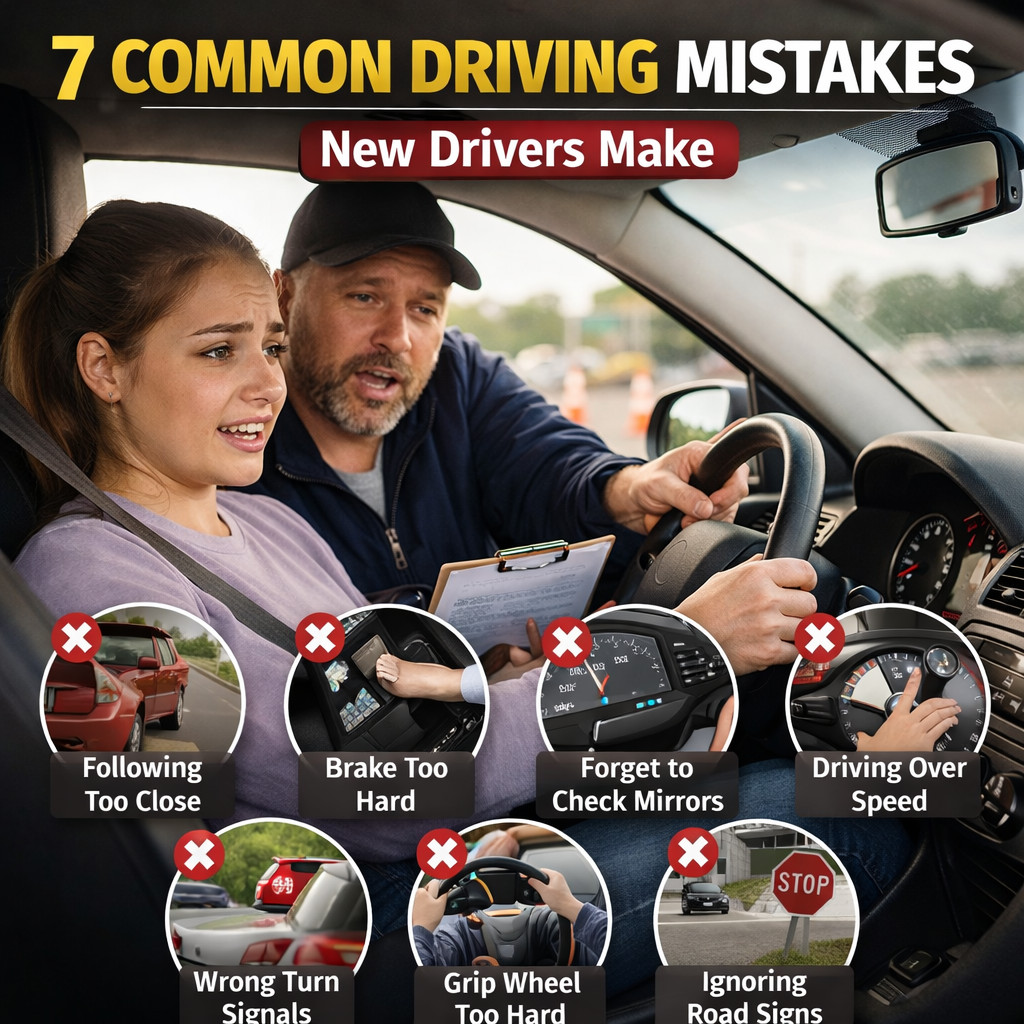
2️⃣ 7 Common Driving Mistakes New Drivers Make


Many beginner drivers make simple mistakes such as forgetting mirrors, braking too hard, or driving too close to other vehicles. Practicing defensive driving and staying calm helps avoid these problems and builds confidence.

image

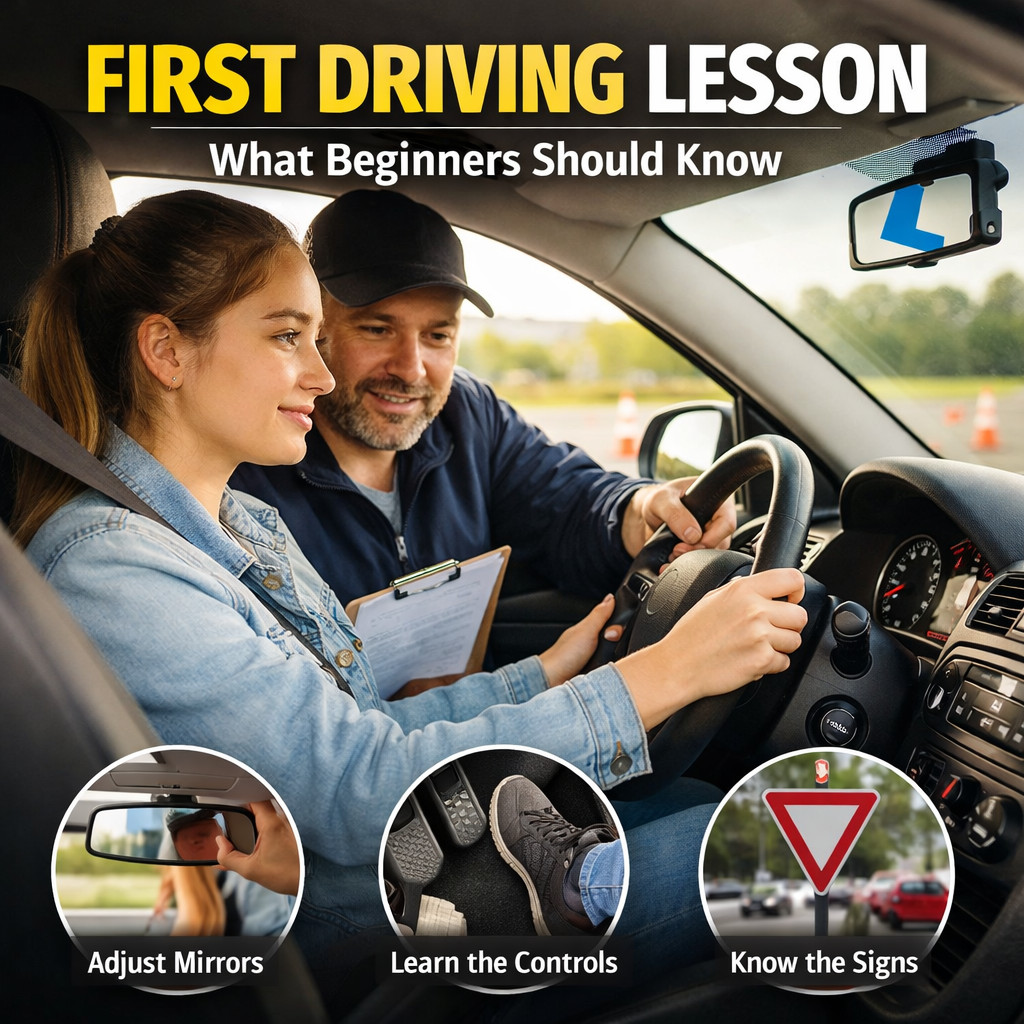
1️⃣ First Driving Lesson – What Beginners Should Know


Starting your first driving lesson can feel exciting and a little scary. Beginners should first learn how to adjust the seat, mirrors, and steering wheel properly. In many European countries like Switzerland and Germany, new drivers must also understand road signs and traffic signals before practicing on busy roads.

image
О нас

Learning to drive is an important life skill that gives you freedom, confidence, and mobility. Whether you are a beginner driver or preparing for your driving test, understanding the basics of safe driving is essential.


Start by learning traffic rules, road signs, and vehicle controls such as the steering wheel, brakes, accelerator, and mirrors. Always practice in a safe area with an experienced driver or professional instructor. Defensive driving helps reduce accidents and keeps both the driver and passengers safe.